Published on November 17, 2026
In Québec, someone who possesses land peaceably, continuously, publicly and unequivocally for 10 years may acquire ownership through acquisitive prescription. A court judgment is still required: possession alone does not transfer title.
Learn more
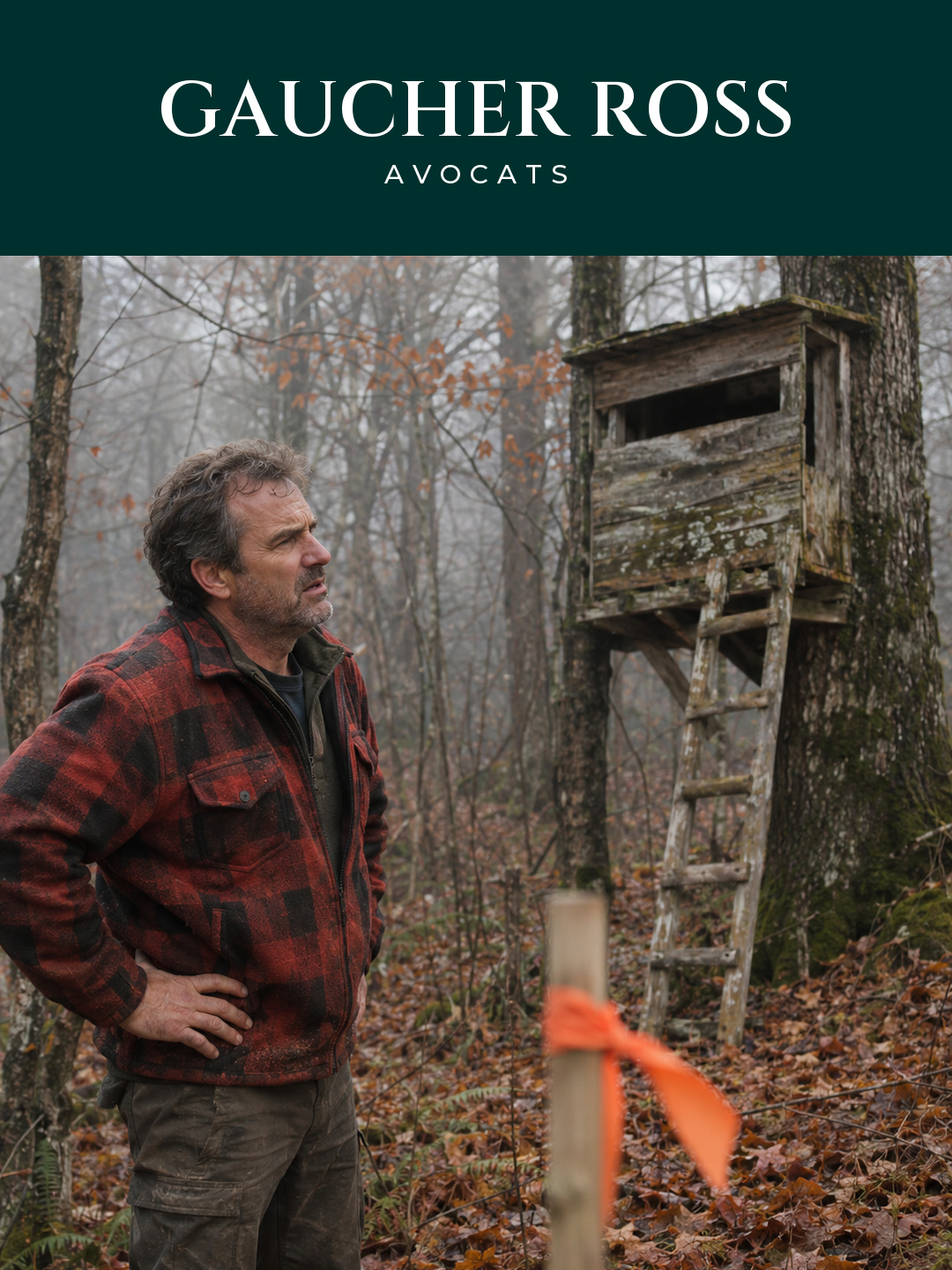
This year, with hunting season approaching, you decided to do things differently: to hunt on one of the lots you own but whose condition you had not checked in several years. So you take the time to walk your lot, study the terrain and identify the spots most likely to bring wildlife into view. And if, during that preparation, you find that a blind has been built on your land without your permission, can you take it down?
Surprisingly, the answer is not as clear-cut as it seems, and here is why.
Acquisitive prescription
In Québec, while ownership of land is usually acquired through a notary, a right of ownership can also arise through the passage of time. The law calls this acquisitive prescription.
Applied to a lot, acquisitive prescription is a legal means of acquiring ownership of a lot or part of a lot after possessing it for at least 10 years — even without ever having bought it. That possession must, however, have been peaceable, continuous, public and unequivocal.
Peaceable
Neither coercion nor violence was used to obtain possession of the property. For example, a hunter walking your lot noticed no installation and met no one before building a blind there.
Continuous
Since taking possession, the possessor performs the acts an owner would normally perform in respect of the property, without anything or anyone preventing it, for at least 10 years. Picture a hunter who returns to the lot regularly and keeps maintaining it.
Public
Possession is not exercised in secret but is instead displayed openly and publicly to others. For example, the hunter invites other hunting enthusiasts to use the lot, and speaks freely and without hesitation about the land he uses.
Unequivocal
The possessor’s acts reveal an unambiguous intention to behave as the true owner of the property. By way of example, the hunter puts up a blind, forbids strangers from using the lot and clears parts of the land.
A judgment is still required
A caution: even where all four conditions are met for 10 years, the possessor does not automatically become the owner. The law provides that a person who has possessed an immovable in this way may acquire ownership of it only by bringing an action at law. It is therefore a court that recognizes the prescription and the right of ownership.
In summary
So if, for a minimum period of 10 years, a person takes possession of your lot peaceably, continuously, publicly and unequivocally, without notifying you and without offering you any compensation, that person may ask the court to recognize their ownership of the lot. This principle, surprising as it may seem, is justified by the law’s preference for granting rights to the person who uses property over the one who no longer looks after it.
In short, whether in a hunting context or not, take the time to check the condition of your lots regularly — and if you notice an installation that is not yours, book a meeting with our team so we can review your situation!